Core guide
How do you check an online casino licence? Match the domain and activity
Work through a dated William Hill register example, distinguishing the business, trading name, domain and remote activity before reaching a limited conclusion.
A logo is the start of a check, not the result
The useful question is whether the online address and business you are looking at match the relevant official record. A regulator logo or a line saying licensed is a claim to investigate. The Gambling Commission’s consumer guidance specifically directs readers to compare licence details, including activities and domain names, with its public register.
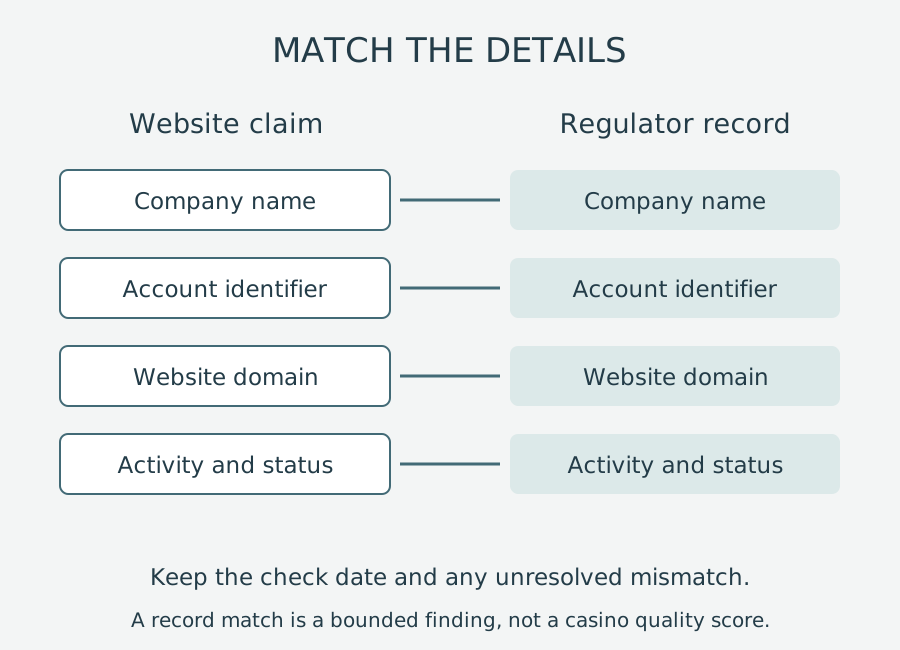
Begin with the website address, the company name stated by the site and any account or licence identifier it supplies. Preserve those details before searching. They give you more than a brand name alone, which can be shared across products, markets or similarly named pages.
Our introduction to the UKGC register provides the short starting route. This guide develops it through a dated William Hill example and an original hostname tool. It is a document check, not a casino recommendation or a legal opinion about every possible arrangement.
The end result should be a sentence whose scope is clear: these specified details matched these official records on this date. That is more useful than an unexplained green badge or a broad claim that a casino has passed every possible safety check.
Sources: UK Gambling Commission: What to look at before you gamble.
William Hill example: identify the business record first
On 13 September 2026, the Gambling Commission’s record for account 39225 named WHG (International) Limited. Its licence summary displayed a remote Casino activity as Active, with the activity’s From field showing 1 November 2014 and To showing Current.
Those are separate fields. The business name identifies the entity record; the account number identifies the register account; Casino identifies an activity; Remote identifies the mode; and Active states the displayed status. Keeping them separate avoids turning one number into a claim about everything associated with the brand.
The From date is also not the date this article performed the check. An activity may have a much earlier start date than the observation. Record both when they serve the explanation, and do not describe the observation as having been made in the historical year.
This example establishes what the retrieved summary showed on the stated check date. Current status can change. A later reader should follow the official source and recheck the relevant record rather than rely on this page as a permanently current status service.
Sources: UKGC public register: WHG (International) Limited licence summary.
Then match the domain and trading-name records
The domain-name page for that same account listed www.williamhill.com as Active when checked. The separate trading-name page listed william hill online as Active. Together with the entity summary, these records provide a concrete connection between the named business, a trading name and a listed domain.
Do not discard the account number while moving between those pages. It is the continuity check that shows you are reading related records rather than mixing a domain list from one business with an activity list from another.
A trading name is not a web address. It may help identify a familiar brand, but it does not substitute for the domain field. Likewise, a company name is not a guarantee that every website displaying a similar name belongs to that company.
The example does not establish a wildcard rule for every address containing the words William Hill. The exact listed domain is the observed fact. If the address you are assessing differs, determine the relevant relationship through the official record and the operator’s verified information rather than assume the difference is harmless.
Sources: UKGC public register: WHG domain names; UKGC public register: WHG trading names.
Read the hostname rather than the most familiar word
A web address can contain a recognisable brand in a path or in a longer hostname. That does not make the address the listed domain. In the invented address www.williamhill.com.example.org, the full hostname is different from www.williamhill.com even though the familiar words appear at its beginning.
The original tool extracts the hostname from a typed example and compares it with the dated domain text used in this article. It does not open the address, query the register or issue a licensing verdict. Its purpose is to expose the exact string being compared.
This distinction is useful when a long address has been copied from an advertisement, message or search result. Read the whole hostname before treating a familiar word as proof of identity. A path such as /williamhill is also separate from the host on which it appears.
A mismatch in the teaching tool does not prove that an address is unlicensed. The tool contains one dated example, not the register’s complete domain inventory. Conversely, a text match does not prove the current page’s legitimacy or current licence status. The next step remains an actual official-record check.
Inspect a typed address’s hostname and compare it with the article’s dated William Hill domain example.
The activity matters as much as the word active
An online casino question concerns the relevant remote activity, not simply the presence of an active entry somewhere on a company’s record. A business can have multiple activities with their own fields. Read the one that answers the question you are investigating.
For the WHG example, the summary contained several activity rows. This guide identified the remote Casino row rather than using another row as a proxy. That is the useful method even when a company has a familiar name and a long record.
Keep domain status and activity status separate as well. An active domain label and an active activity are related pieces of evidence, but they are not the same field. A screenshot cropped to one word may remove the information needed to know which status it is showing.
If a record contains a qualification, date range or additional note, retain it in the explanation. Do not rewrite unfamiliar wording into a simple positive result before understanding its scope. A clear unresolved finding is preferable to an unsupported claim that every relevant permission has been confirmed.
Sources: UKGC public register: WHG (International) Limited licence summary.
A foreign badge answers a separate jurisdiction question
A gambling brand can show more than one regulator or operate in more than one market. The existence of a foreign badge does not answer the specific Great Britain register comparison in this guide. Our note on foreign licence badges explains why each claim needs its own relevant check.
Keep the intended customer market with the source. A footer or terms page selected for another country may name a different business or permission. That can be a meaningful distinction rather than a spelling error to normalise away.
For an invented comparison, one document says Company A serves Market A and another says Company B serves Market B. Combining the company from the first with the regulator from the second would create a relationship neither document states. The brand name can be the same while the customer context differs.
This guide does not determine the law of every jurisdiction. Its worked record concerns the Gambling Commission and an identified remote activity. Questions about a different market require the appropriate primary sources for that market instead of a general assumption that one badge covers all countries.
Handle a missing match without inventing a conclusion
If a domain or company does not match, preserve exactly what you searched and what the record returned. Check for a transcription error and whether the website supplied a different legal name or account identifier. A failed first search is an observation about that search, not a complete investigation.
If the mismatch remains, pause before relying on the site’s licensing claim. Seek clarification through the regulator’s or verified business’s published contact route. Do not send sensitive documents or money merely to test whether a questionable address responds.
Keep a screenshot or note of the relevant public claim and the official result with dates. The useful record shows which field differed. A broad accusation without that detail is harder to investigate and may go beyond what the evidence supports.
Where the record matches, keep the conclusion bounded. It does not calculate payout speed, assess every bonus term, guarantee a dispute outcome or make gambling risk-free. Those are different questions requiring different evidence.
Keep the check reproducible
A compact licence-check record needs the address inspected, the entity and account identifier, the relevant activity and status, the domain entry and the observation date. Add source links to the exact pages rather than only the regulator homepage.
Separate the register’s displayed activity dates from your own access timestamp. If a page says Current, preserve that word as part of a dated observation rather than assign a future end date. If you could not load one of the required pages, record that access problem explicitly. It is different from successfully loading a page that contains no matching entry. A reader should be able to tell whether the uncertainty comes from missing access, a missing field or a substantive mismatch.
When revisiting the record, compare those fields again. If one changes, update the affected claim and retain the new date. The aim is a clear source trail that a reader can follow, with each match or unresolved difference stated at the scale the evidence supports.
Questions answered
What did the William Hill example show?
On 13 September 2026, the cited register pages showed WHG (International) Limited, account 39225, with an active remote Casino activity and www.williamhill.com listed active. Recheck the official record for current status.
Does a gambling logo prove the website is licensed?
No. Compare the business, domain, relevant activity and status with the official record. A logo is a claim, not the completed comparison.
Is the hostname tool a live UKGC checker?
No. It only compares text with the dated example in this article. It does not fetch register data or decide whether an address is licensed.