Facts checked Article
Casino licence verification
The casino licence is surrendered and your dispute is still open
Build a dated status record that separates licence surrender, website closure and the unresolved account issue, without treating the register as a payment decision.
Record three events before drawing a conclusion
A surrendered operating licence is evidence about licensing status. It is not a decision on whether your account complaint succeeds or whether a payment has arrived. If a casino dispute is still open, begin by recording three events separately: the licence-status change, the website's closure or access change, and the complaint's own history.
The Gambling Commission's closure guidance explicitly distinguishes business closure from licence surrender; their dates need not coincide. Section 113 of the Gambling Act 2005 describes surrender as a route by which an operating licence ceases to have effect. Neither source allows a reader to treat an unresolved balance as settled merely because a status label changed.
Licence Lens's method here is a chronology check. It identifies which company and record each event belongs to, then marks unsupported links between them. It is intended for adult readers of online casino documents concerning Great Britain. It does not calculate compensation or decide the merits of a private claim. No personal account, live withdrawal or individual dispute was inspected for this article; the worked file below is explicitly hypothetical.
Sources: Closing a Gambling Commission licensed gambling business; Gambling Act 2005, section 113.
Preserve the old claim without calling it current
If you already have an earlier footer, terms document or register observation, preserve its date and origin. A saved page can establish what you recorded at that time. It does not establish what the licence says now. Conversely, today's record should not erase the company name under which an earlier disputed transaction occurred.
Create two identity lines in the file: the business named in the earlier account documents and the business named in the current official record. Copy legal names carefully, together with any account number and domain. If they differ, describe the difference before explaining it. A shared brand or similar name is not enough to establish that the same company is responsible for every event.
This is an editorial record-keeping method, not a claim that every reader possesses a complete historical archive. Missing earlier evidence should remain missing. Write that the earlier status was not independently checked if all you have is an old website claim. That wording is more useful than reconstructing an apparently exact licensing history from memory, a search snippet or a current footer with no preserved earlier copy.
Read surrender as a status, then locate its date
The statutory surrender provision concerns the operating licence and notification to the Commission. For a reader, its significance is that surrender should be treated as a specific licensing event. It should not casually be relabelled revocation, suspension or insolvency. Those words introduce different assertions, which this article has not established for an individual operator.
When the source provides a status date, record it separately from the date you retrieved the page. If the current page displays a status but no event date, preserve that limitation. A timestamp on your saved file proves when you collected it, not when the status first changed. Likewise, a news publication date may report an earlier event rather than identify its precise legal effective time.
The Commission's closure guidance says that surrender is confirmed through its licensing process and that the public register is updated afterwards. The practical response is to read the current record and relevant official notice together. If they appear inconsistent, document the inconsistency and seek clarification; do not manufacture a missing date to make the timeline look orderly.
Sources: Gambling Act 2005, section 113; Closing a Gambling Commission licensed gambling business.
The TGP notice is a dated example, not your account record
On 16 May 2025, the Commission published a notice explaining that TGP Europe had surrendered its licence and left the British market following its investigation. The notice describes TGP's white-label model as operating gambling businesses using other businesses' branding. It illustrates why a familiar public-facing name and the licensed operator need separate entries in a research file.
The notice also directed customers with account questions to the operator and described the expectation of an orderly closure with information about obtaining funds. That is a useful distinction between a regulatory announcement and an account-specific answer. The notice cannot tell an unrelated reader whether their own disputed amount was accepted, rejected or paid.
This article does not recheck the current status of every former TGP domain or establish a present contact channel for an individual brand. It uses the official notice as a historical example of the evidence type. A reader working on another operator should replace it with that operator's own official record. Similar-looking closure circumstances do not make one company's announcement evidence for another company's liabilities.
Sources: TGP Europe leaves GB market following Commission investigation.
Keep the contact route attached to the old operator
The Commission's closure guidance expects information for customers with complaints and continued access to an alternative dispute resolution service. It also says that a contact method should remain available after closure for complaints or unclaimed funds. These are expectations of the closing business, not a promise that every contact link will work or that every claim will be recovered.
Record the channel the operator actually supplies in its closure communication, along with the message date. A current register entry helps identify the business; a complaint or closure document helps identify the route it has provided. A new website under a familiar brand should not automatically be treated as the old complaint desk. The documentary connection needs to be established.
If you cannot verify a contact route, state that precisely in the record. Do not send sensitive account evidence to an address merely because it appears in a forum discussion. This article supplies no replacement address and makes no claim to have contacted an operator. Its contribution is the identity check that should precede using a route, while leaving the actual account correspondence to the reader and the relevant business.
Sources: Closing a Gambling Commission licensed gambling business; Complain about a gambling business.
Separate a report to the regulator from a payment dispute
The Commission's consumer guidance says it does not decide complaints about gambling transactions. It directs a customer to complain to the gambling business first. Its complaints procedure describes providing dates, times, amounts and evidence, keeping copies, and allowing the business eight weeks from receipt to resolve the complaint. It also explains the possibility of escalation to an ADR provider after the operator process.
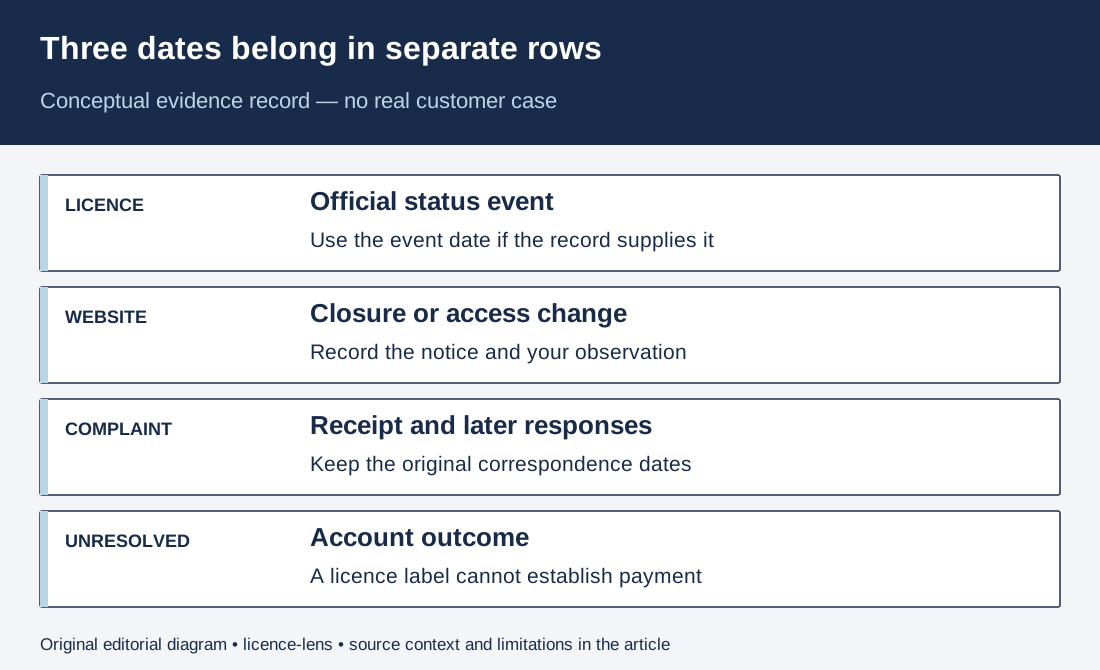
For this status check, preserve the original complaint-receipt date and any later responses. Do not replace it with the day you discovered a surrender notice. These dates answer different questions. One concerns a complaint process; the other concerns your knowledge of a licensing event. A tidy chronology should let another reader distinguish them immediately.
Whether a particular ADR provider can consider a particular closed-business dispute requires checking that provider's applicable scope and instructions. This article has not performed that case-specific check and does not promise acceptance or recovery. Payout Ledger's explanation of withdrawal stages can help identify the payment evidence itself; Licence Lens remains concerned with which operator and licensing record those documents belong to.
Sources: Complain about a gambling business; How to complain.
Use a mismatch sheet instead of a verdict
Consider a hypothetical file with an earlier footer saved on Day A, a complaint acknowledgement on Day B and a surrendered status observed on Day C. These labels are invented teaching labels, not dates in a real customer's case. Suppose the saved footer names Company One, while the latest brand page names Company Two. The evidence does not yet prove that Company Two inherited the earlier account dispute.
The next useful step is to seek the document that connects the entities or explicitly identifies who is handling the old accounts. Until that exists, the connection belongs in the unresolved column. The same discipline applies when a domain stops loading: loss of access is an observation, not proof of insolvency or extinction of a claim.
The comparison table turns this into a small evidence sheet. Every row should end with the question the record can actually answer. Avoid a single green tick headed safe or resolved. A case can have a verified surrender notice and an entirely unresolved payment issue at the same time. A mixed result is an accurate result, not a failure of the checking process.
| Evidence | Record separately | Question it answers |
|---|---|---|
| Earlier account terms or footer, Day A | Named entity, domain, saved source | Who was named in the earlier account material? |
| Complaint acknowledgement, Day B | Recipient, receipt date, reference | When did that business acknowledge the complaint? |
| Official status observation, Day C | Entity, status, event date if supplied, retrieval date | What status did the official record show when checked? |
| Closure message | Sender, date, contact instructions | What route did the closing operator provide? |
| Later brand or operator name | Document connecting old and new entities, if any | Is continuity evidenced or still unresolved? |
Write the conclusion so it can be checked later
A useful conclusion has room for both findings and gaps. For example: the official record inspected on this date shows this status for this entity; the earlier account material names this entity; the available documents do or do not connect the two; the account outcome is not established by these licensing records. Populate that sentence only with observations you can support.
Keep the sources with their original retrieval dates. If you inspect them again, add a new observation rather than backdating it. Retain an official announcement as a historical source even if the current register later changes. The purpose is to preserve what each document establishes, not to force all documents into the same tense.
Before relying on the file, check for a newer official notice and review any current closure instructions. The resulting record may still contain an unanswered identity or contact question. That should remain visible. Licensing verification can establish who and when; it cannot, on its own, supply the missing decision about an individual casino account.
Questions answered
How can I check a casino license?
Use the official business record and match the entity, domain, activity and status. For a surrendered licence, preserve both the observation date and any stated event date.
What does the register show that a website footer does not?
It provides the regulator’s record of the business and its licensing details. A footer is the website’s own claim and may be an older observation.
Can a surrendered operating licence simply be reinstated?
The Commission’s closure guidance says a new application is needed after surrender. Do not interpret an old badge as evidence that the surrendered licence became active again.
Does the Commission decide my withdrawal complaint?
Its consumer guidance says it does not decide complaints about gambling transactions. Start with the operator’s complaints process and check the applicable escalation route.
Does a website closing prove that the company is insolvent?
No such conclusion follows from the website observation alone. Record the closure and look for evidence addressing the company’s actual position.
Official sources
Continue reading
Start with the Gambling Commission's register
For a gambling business claiming a Gambling Commission licence, begin at the Commission's own business register.
Read Start with the Gambling Commission's register
A foreign licence badge is a separate check
If a site refers to the Malta Gaming Authority, use the MGA's official Licensee Register and URL Checker.
Read A foreign licence badge is a separate check
A casino company number is not evidence of a gambling licence
Separate a company record, a trading name and a Gambling Commission account before deciding what an online casino’s identity documents establish.
Read A casino company number is not evidence of a gambling licence
Is casino legit: the procedure, field by field, with a worked check
Whether a casino is legit is a five-field check on the Gambling Commission’s public register, not a verdict. Three real entries followed through on 21 September 2026: a domain resolved as White Label, a brand resolved through Trading names, and a company whose licences show Surrendered.
Read Is casino legit: the procedure, field by field, with a worked check
How to check an online casino licence against the Gambling Commission register, field by field
How to match a casino footer to the Gambling Commission register: legal name, account number, domain, activity and status, worked on a real white-label brand.
Read How to check an online casino licence against the Gambling Commission register, field by field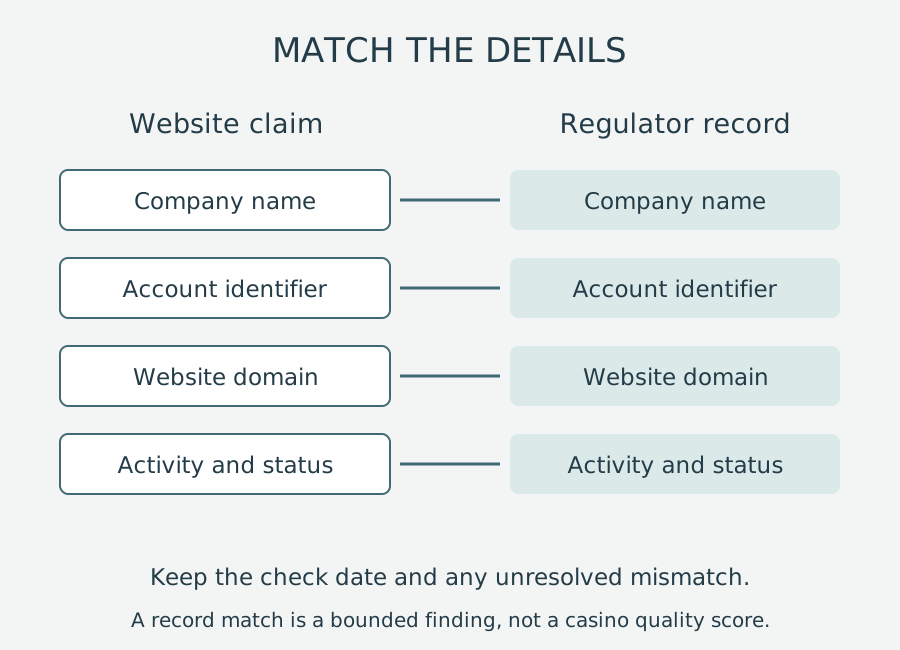
How do you check an online casino licence? Match the domain and activity
Work through a dated William Hill register example, distinguishing the business, trading name, domain and remote activity before reaching a limited conclusion.
Read How do you check an online casino licence? Match the domain and activity
Continue reading
Is casino legit: the procedure, field by field, with a worked check
Whether a casino is legit is a five-field check on the Gambling Commission’s public register, not a verdict. Three real entries followed through on 21 September 2026: a domain resolved as White Label, a brand resolved through Trading names, and a company whose licences show Surrendered.
Read Is casino legit: the procedure, field by field, with a worked checkA casino company number is not evidence of a gambling licence
Separate a company record, a trading name and a Gambling Commission account before deciding what an online casino’s identity documents establish.
Read A casino company number is not evidence of a gambling licenceStart with the Gambling Commission's register
For a gambling business claiming a Gambling Commission licence, begin at the Commission's own business register.
Read Start with the Gambling Commission's registerFollow a licence-checking workflow
Start with the Gambling Commission's register
A foreign licence badge is a separate check
How to check an online casino licence against the Gambling Commission register, field by field
A casino company number is not evidence of a gambling licence
How do you check an online casino licence? Match the domain and activity
Is casino legit: the procedure, field by field, with a worked check